Does Your Platform Decide Whether AI Understands You?
Being on a good ecommerce platform doesn't mean AI understands your products. Here is why interpretability is a property of your data, not your storefront.
There's a comforting assumption a lot of merchants make: I'm on a serious platform, so I'm covered. On the flip side, there's an anxious one: this must only matter for stores on some other setup, not mine.
Both come from the same idea — that your ecommerce platform determines whether AI can understand your catalog. It's worth stating plainly: it doesn't.
What your platform actually controls
Your platform decides how you operate — how you manage inventory, take payments, build pages, and run the day-to-day of the store. Modern platforms are good at this, and they give you fields and structure to hold your product information.
But giving you fields is not the same as filling them with meaning, and it's certainly not the same as guaranteeing that the meaning resolves for a machine. A platform hands you the containers. What goes in them, and whether a machine can understand what's in them, is a separate question the platform doesn't answer for you.
Two stores, same platform, worlds apart
Take two merchants on the exact same platform. One has products whose meaning is fully expressed — clear on what each item is, who it's for, when it fits. The other has beautiful pages and empty meaning underneath. To a human browsing, they might look comparable. To the third reader, they are not remotely the same.
The platform was identical. The interpretability wasn't. That tells you interpretability was never a platform property in the first place — it's a property of the data, of how completely and legibly the meaning of each product is expressed.
A great platform with hollow meaning is still opaque to a machine. A humble setup with well-expressed meaning can be perfectly legible. The storefront is not the deciding factor.
The reader doesn't know where your catalog came from
Here's the clarifying image. An AI system reading your product has no idea, and no interest in, which platform published it. It didn't come to admire your storefront. It reads the meaning it's given and acts on that.
To that reader, "I'm on a leading platform" is not an answer to "can you understand this product?" The only thing that answers that question is the product data itself.
(So if it's not your platform, and it's not a cleaner feed either, how would you even know where you stand? That's next: Would You Even Know If AI Couldn't Read Your Catalog?)
Why this is good news
If interpretability lived in your platform, fixing it would mean the nightmare every merchant dreads: re-platforming. It doesn't, so it doesn't. You don't have to migrate anything to become AI-ready.
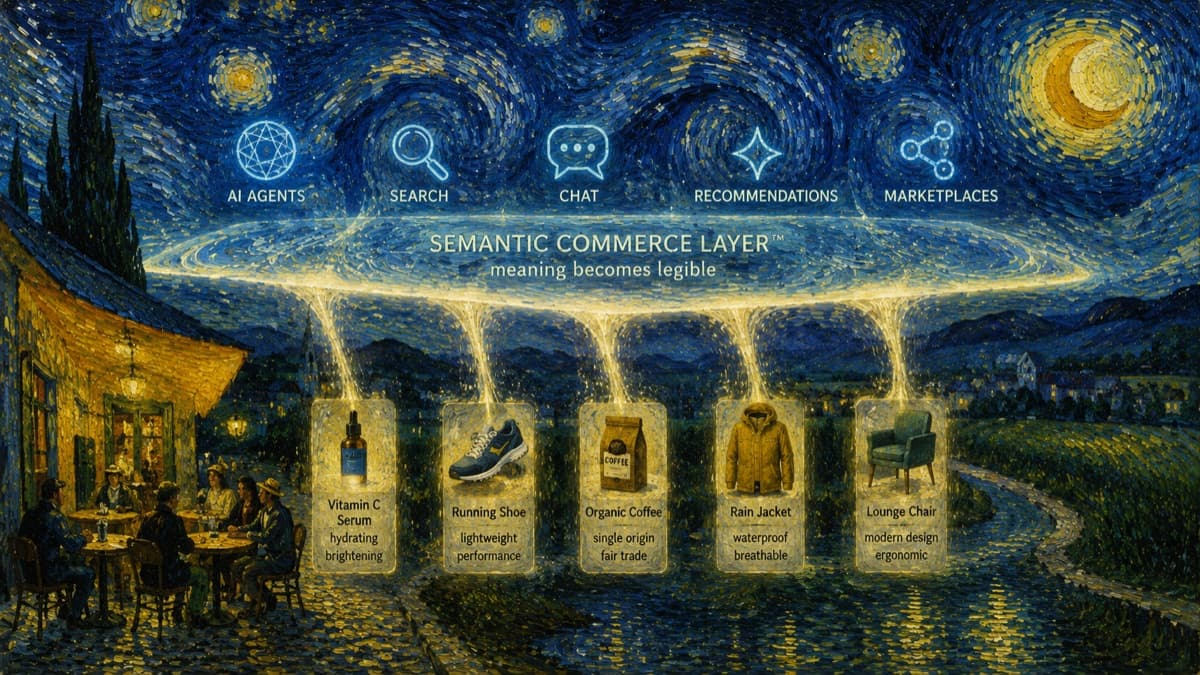
The work lives in the meaning layer that sits above any platform — the Semantic Commerce Layer™, which doesn't replace your store or your platform; it makes the products you already have interpretable, wherever they happen to be hosted. Whatever you're running today can be made legible to the third reader without tearing it down.
Your platform runs your store. Making your catalog understandable is a layer that sits on top of whichever platform you chose.
Find out where your catalog stands
→ Run the free Agentic Catalog Readiness Audit™ — it reads your products, not your platform, across all three dimensions.
→ Read the complete Research Paper — The Semantic Commerce Layer™, the full framework behind this series.
Continue the series
← Previous: Isn't This Just the Feed Tool You Already Pay For? · ⌂ The Semantic Commerce Layer™ (Research Paper) · → Next: Would You Even Know If AI Couldn't Read Your Catalog?
Series: The Semantic Commerce Layer™ (F-RP001) · Knowledge Domain: Foundation
NSOLVIA Intelligence — Products generate knowledge. Knowledge generates authority.