The Semantic Commerce Layer™
Making Catalogs Readable to AI Systems
Executive Summary
Presence is no longer the bar. Interpretability is.
Commerce infrastructure was built for databases. The next generation of commerce is being built for machines that reason.
A growing share of product discovery, comparison, and recommendation now happens through AI systems acting on behalf of users. These systems do not browse the way humans do. They read structure. And most product catalogs, though perfectly adequate for human shoppers and traditional search, were never structured for machine interpretation.
The result is a widening gap between what merchants publish and what intelligent systems can understand.
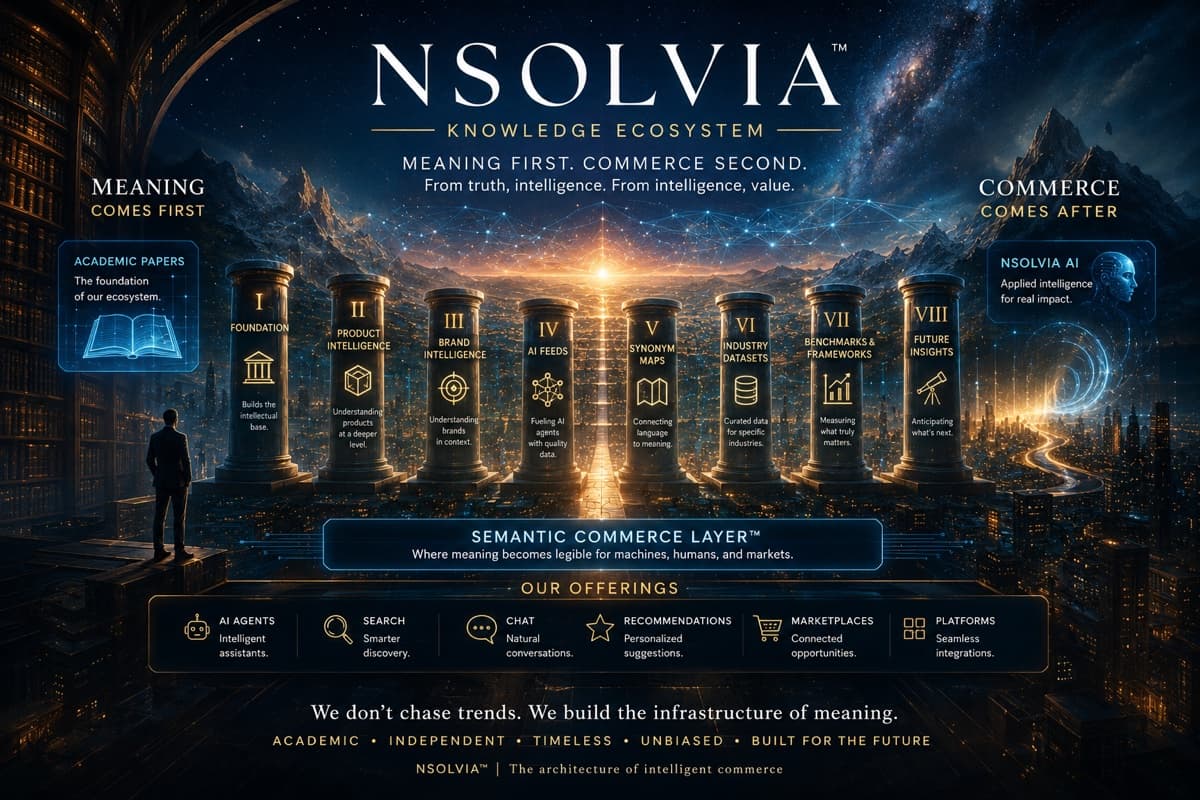
The Semantic Commerce Layer™ is NSOLVIA's proposed framework for transforming fragmented commerce data into structured, machine-interpretable commerce information. It does not replace existing catalogs, feeds, or marketplaces. It sits alongside them, enriching product data into a form that modern systems can read consistently.
Put simply: the Semantic Commerce Layer™ is the interpretability layer between merchant catalogs and intelligent systems. A clean feed of unstructured meaning is still unstructured meaning — formatting moves data, but it does not make an ambiguous product understandable. That is the gap this layer addresses.
This paper defines the problem, situates it against where the industry is heading, presents observed evidence from real catalog transformations across multiple platforms, and proposes a way to measure catalog readiness. It makes no promise about rankings or sales. Its claim is narrower and more durable: products that machines cannot interpret will struggle to participate in machine-driven commerce.
1. The Industry Problem
For more than two decades, digital commerce has been optimized for two readers: the human browser and the traditional search engine. Catalogs were designed around the fields those readers needed — title, description, brand, price, category, images.
Those fields remain essential. But a third reader has arrived, and it reads differently.
AI systems that recommend, compare, and retrieve products require more than a record exists. They require context: when a product should be surfaced, why a buyer would choose it, which use cases it serves, how it relates to alternatives. A product can sit fully present inside a catalog and still be effectively unreadable beyond its most basic attributes.
This creates a visibility gap — not between products that exist and products that don't, but between products that are listed and products that are structurally understandable.
2. Signals From the Market
Leading research firms increasingly converge on a single operational message: merchants will need cleaner, more structured, machine-readable product data to participate in AI-driven commerce.
The size of that future market is genuinely uncertain. Public estimates range widely — from roughly US$144 billion to multiple trillions — a spread driven less by precision than by how each firm defines "agentic commerce." McKinsey, at the higher end, has projected agentic commerce could orchestrate up to US$1 trillion in U.S. retail by 2030. The exact figure is debatable.
The direction is not.
More telling than any forecast is the recommendation those same firms make to merchants: clean your catalog feeds, expose structured product data, keep availability current — or risk disappearing from automated, machine-mediated purchase paths.
The leading firms agree that merchants will need more structured, current, and accessible data to participate in AI-driven commerce.
Most merchants already have products online. The challenge is no longer publication. The challenge is interpretation.
That is the premise this paper builds on. Not the size of the prize — the structural requirement to compete for it.
Sources: McKinsey/ICSC projections on agentic commerce — up to ~US$1T in U.S. B2C orchestrated retail revenue by 2030 (moderate scenario) and ~US$3–5T globally — and ~50M daily shopping-related queries on ChatGPT, as reported in industry coverage, 2025–2026. The estimate range (from ~US$144B at the lower end to multi-trillion) reflects differing definitions of "agentic commerce."
[1] Retail Dive — https://www.retaildive.com/news/agentic-commerce-us-one-trillion-2030/818936/
[2] Digital Commerce 360 — https://www.digitalcommerce360.com/2025/10/20/mckinsey-forecast-5-trillion-agentic-commerce-sales-2030/
[3] MetaRouter — https://www.metarouter.io/post/the-agentic-commerce-opportunity-for-retailers
[4] eMarketer — https://www.emarketer.com/content/consumers-cozy-up-agentic-commerce-retailers-face-big-decisions
3. Why This Matters Now
Several shifts are arriving at once, and each one changes who does the reading.
AI search is replacing part of traditional query-and-click discovery with systems that answer directly. Conversational commerce lets buyers describe what they want in natural language rather than navigating categories. Recommendation systems increasingly decide what a shopper sees before the shopper searches at all. And machine-mediated discovery — agents acting on a person's behalf — is moving from experiment to infrastructure.
In each case, the entity evaluating a product is no longer only a human scanning a page. It is a system parsing structure. A product described well enough for a person can still be opaque to the machine now standing between that product and its buyer.
The timing is the point: the readers are changing faster than the catalogs are.
4. Why Traditional Catalogs Struggle
Most catalogs were built for display. Modern systems increasingly require interpretation.
Consider a single catalog entry:
"Birthday Cake Cereal"
A human reads that and understands it instantly — the flavor, the occasion, the aisle. A machine may not. The information that lets a system decide when to recommend it, to whom, and why is implicit: target audience, intended use, functional purpose, product relationships, purchase motivation.
The challenge is not the absence of data. It is the absence of structure. And as catalog size grows, the missing structure compounds — thousands of products, each slightly unreadable, become a catalog that machines navigate poorly.
5. The Semantic Commerce Layer™
The Semantic Commerce Layer™ is a framework for transforming product information into structured, machine-interpretable commerce data. Stated as a definition: it is the interpretability layer between merchant catalogs and intelligent systems.
It is not a replacement for existing systems. It operates as an additional layer that enriches product data — improving:
- Product clarity
- Category precision
- Contextual understanding (use cases, intent)
- Structured attributes
- Discoverability potential
Conceptually, it sits in one place in the flow:
   Merchant Catalog  →  Semantic Commerce Layer™  →  Feeds · APIs · AI Systems
   (built for humans     (interpretability:           (the readers that now
    and databases)        structure + meaning)         evaluate the product)
The objective is simple to state: transform fragmented product records into data that machines can understand consistently. What the layer produces is the point of this paper. How it produces it is NSOLVIA's own work and is outside this document's scope.
It is worth separating three terms the technical reader will otherwise blur together, because the distinction is where the value sits:
- Normalization turns inconsistent data into consistent data — the same attribute expressed the same way across products.
- Enrichment adds useful information that was implicit or missing — use cases, intent, structured attributes.
- Interpretability is the outcome of both: a product a machine can actually understand and act on.
Normalization and enrichment are means. Interpretability is the end. A catalog can be perfectly normalized and still uninterpretable; it can be partially enriched and still ambiguous. The Semantic Commerce Layer™ is organized around the end state — machine interpretability — not around any single technique that contributes to it.
Stated plainly for the merchant: we do not replace the catalog. We make it understandable to machines. No platform migration, no catalog rebuild — the existing catalog stays where it is and becomes interpretable.
The Semantic Commerce Layer™ is designed to complement traditional feeds, marketplaces, recommendation systems, and emerging AI commerce environments — not to compete with them.
6. Built for Many Platforms, Not One
Commerce does not run on a single platform, and a framework that only works on one is not infrastructure — it is an integration.
The Semantic Commerce Layer™ is platform-agnostic by design. The transformation observed in this paper has been applied to catalogs across Shopify, WooCommerce, Wix, and Squarespace, as well as direct-to-consumer storefronts. The same structuring logic applies regardless of where the catalog lives, because it operates on product meaning, not on any one platform's format.
This matters for two reasons. First, merchants are not locked to a single channel, and neither should their AI-readiness be. Second, a framework that holds across platforms is far harder to dismiss as a quirk of one ecosystem — the consistency is the evidence.
7. Why This Is a Layer, Not a Feature
A reasonable objection: isn't this just feed enrichment, something existing feed-management tools already do?
The distinction matters. Traditional feed tools format and route existing catalog data to channels. They move data; they largely preserve its structure. The Semantic Commerce Layer™ addresses a different problem — not where the data goes, but whether a machine can interpret it once it arrives.
Formatting a catalog for a channel does not make an ambiguous product interpretable. A clean feed of unstructured meaning is still unstructured meaning. The layer sits upstream of distribution: it is concerned with the interpretability of the product itself, across whatever channels and protocols carry it.
That is why it is framed as a layer in the stack rather than a feature of any single tool — it is the interpretive substrate the other pieces depend on.
8. The Agentic Catalog Readiness Score™
To discuss catalog readiness, it helps to be able to measure it. NSOLVIA proposes the Agentic Catalog Readiness Score™ as one way to do so. It measures how ready your product catalog is for AI agents and machine-driven commerce.
The score is a proposal, not an industry standard. It is a directional indicator of how interpretable and discoverable a product's data may be to modern systems. If a better measure emerges, we will adopt it. It is explicitly not a prediction of rankings, traffic, or sales.
The score considers three dimensions:
- Structural Score — identifiers, images, structured attributes.
- Semantic Score — category precision, product type, use cases, functional intent. The dimension most closely associated with machine interpretability.
- Discoverability Score — the signals platforms use to surface and recommend a product.
Suggested interpretation of the combined result:
| Range | Reading |
|---|---|
| 80–100 | Appears well to AI systems |
| 50–79 | Partially interpretable |
| 0–49 | Largely invisible |
The score is a directional measurement, not a guarantee of performance. (The internal weighting is intentionally not published; the bands above are sufficient to use the score directionally.)
9. Evidence: Observed Catalog Transformations
This section presents observed results, not a controlled study. The intent is to illustrate the kind of transformation the Semantic Commerce Layer™ produces, and to share one pattern that emerged consistently across a larger sample.
Two of the examples come from PonteBella, the live merchant NSOLVIA operates as its reference deployment; the rest are independent merchant catalogs audited by NSOLVIA.
9.1 — Representative examples
Five catalogs, across five verticals and four platforms. Merchant identities anonymized except where NSOLVIA owns the store.
| Vertical | Platform | Before | After | Lift |
|---|---|---|---|---|
| Shapewear (PonteBella) | Shopify | 36 | 83 | +47 |
| Beverage | WooCommerce | 15 | 80 | +65 |
| Apparel | Wix | 20 | 68 | +48 |
| Breakfast / supplements | DTC | 15 | 75 | +60 |
| Skincare (PonteBella) | Shopify | 29 | 80 | +51 |
A worked example (shapewear, PonteBella — named with permission):
- Before: category "Shapewear" (generic); no use cases; no functional intent.
- After: category resolved to `apparel_shapewear`; product type "waist trainer"; use cases everyday, postpartum, gym; functional intent waist shaping, breast lifting; size and color variants structured.
In every example, the largest gain occurred in the Semantic dimension — the dimension most closely associated with machine interpretability. A generic title became information a machine can act on.
9.2 — A pattern across 80 audits
Across a sample of 80 audited catalogs, a consistent pattern emerged around one factor: whether a product's category could be resolved into a structured value.
- In the 65 catalogs where category resolved successfully, the average visibility lift was +48.4 points (average after-score 68).
- In the 15 catalogs where category could not be resolved, the average lift was +7.3 points (average after-score 24).
Notably, both groups started from nearly the same average before-score (≈19 vs ≈18) — the divergence appeared after enrichment, not before it. Where category remained ambiguous, the Semantic dimension consistently collapsed toward zero regardless of the catalog's initial structural quality.
Category Resolution Hypothesis (observational): In our sample, catalogs whose category could be resolved tended to show substantially larger gains in interpretability than those whose category remained ambiguous. Category resolution appears to be one of the strongest observed predictors of semantic interpretability in our sample.
This is a correlation observed in a sample of 80, not a law of the industry. It is offered as a finding, not a claim. Category is one of several signals the Semantic Commerce Layer™ structures — alongside use cases, functional intent, materials, and purchase signals — and its relative weight is a question continued auditing will refine.
10. Compatibility With Existing Ecosystems
The Semantic Commerce Layer™ is built to interoperate, not to replace. It is designed to coexist with:
- Schema.org structured data
- Merchant Center and platform feeds
- Marketplace catalogs
- Commerce APIs
- Emerging AI commerce protocols (e.g. MCP, ACP, UCP)
These protocols define how agents and platforms exchange and transact commerce data. The Semantic Commerce Layer™ is concerned with what they exchange — whether the underlying product data is interpretable in the first place. The layer feeds the protocols; it does not compete with them.
Importantly, these protocols will evolve — some will consolidate, others may be replaced, and new ones will appear. The interpretability problem exists independently of which protocol prevails. A product that machines cannot understand remains a problem under any standard. That is why this framework is defined around interpretability rather than around any single protocol of the moment.
The objective is interoperability, not replacement.
11. What This Paper Does Not Claim
In the interest of precision, this paper explicitly does not claim:
- Guaranteed rankings on any platform.
- Guaranteed recommendations or surfacing by any AI system.
- Guaranteed increases in traffic or sales.
- Preferential treatment from any AI platform, protocol, or marketplace.
No such guarantee is currently possible — commerce AI protocols are still being defined, and ranking behavior is controlled by the platforms, not by any data provider. This paper's scope is limited to the quality, structure, and interpretability of commerce data. What systems do with better-structured data is theirs to decide.
Conclusion
Catalogs were built for databases. The next generation of commerce requires catalogs that machines can understand.
As AI systems take a larger role in discovery, recommendation, and purchasing, the merchants who participate will be those whose products can be interpreted — not merely those whose products are online. Presence is no longer the bar. Interpretability is.
The Semantic Commerce Layer™ is one approach to closing that gap: a way to turn fragmented product data into structured meaning that machines can read, across platforms and across the protocols now taking shape.
The future of commerce may depend less on whether products are online, and increasingly on whether intelligent systems can understand them.
The merchants of the next decade may not be distinguished by who has the largest catalog, but by whose catalog can be understood.
Explore this framework.
Run the free Agentic Catalog Readiness Audit™ →
Or start the companion series — Your Products Are Online. Why Can’t AI See Them? — eight articles that walk the argument step by step.
Once a catalog is ready, the next step is delivery. Explore NSOLVIA DATA — how a ready catalog becomes clean, agent-consumable feeds.
Knowledge Domain: Foundation · Document: F-RP001 · Research Paper
NSOLVIA Intelligence — Products generate knowledge. Knowledge generates authority.
The Semantic Commerce Layer™ and Agentic Catalog Readiness Score™ are trademarks of NSOLVIA. © NSOLVIA · Juan Carlos Lopez, Founder.