Would You Even Know If AI Couldn't Read Your Catalog?
The signals you normally check all measure human appeal, not machine readability. Here is how to actually see whether AI can read your catalog.
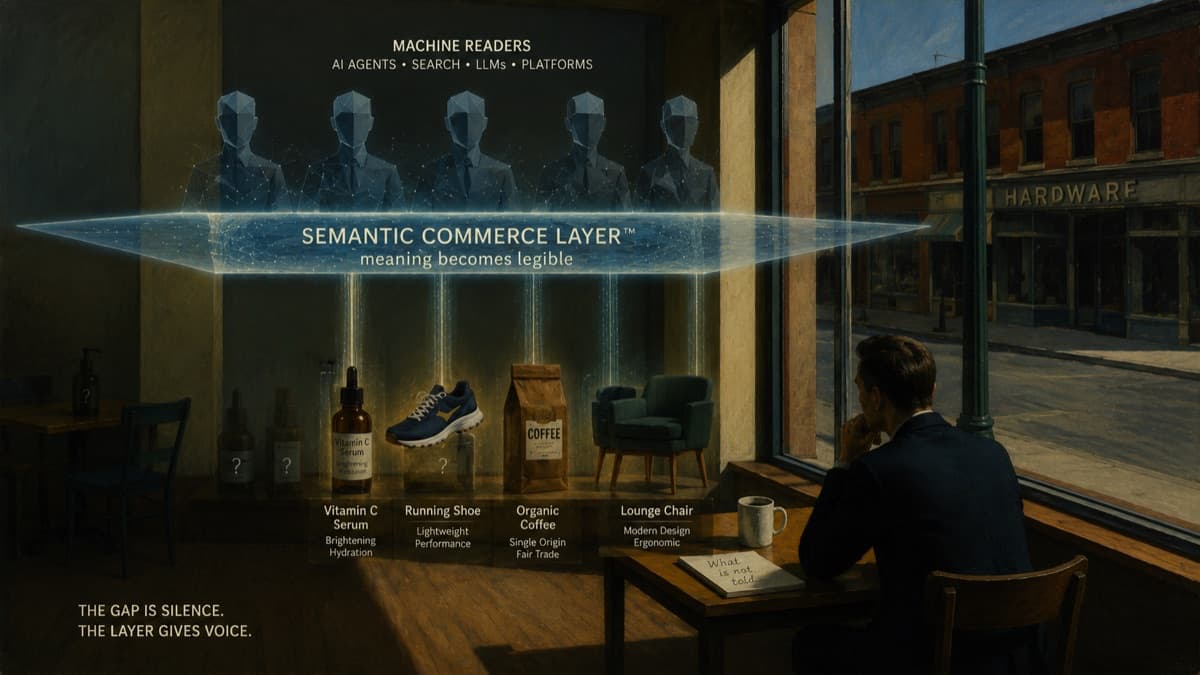
Sit with the honest version of the question for a second. If the systems now shaping what shoppers see couldn't understand your catalog — would you know? What, exactly, would tell you?
For most merchants, the answer is nothing would. And that's not carelessness. It's that every instrument on the dashboard was built to measure a different thing.
Everything you already check measures the wrong reader
Your sales look fine. Your traffic looks fine. Your catalog looks complete when you open it. These are the signals you trust, and every one of them is a human-facing signal — evidence that people can find, read, and buy your products.
None of them measures whether a machine can understand those same products. A catalog can be fluent to every human who visits and quietly illegible to the third reader, and not one number on your current dashboard would move. You can't see this gap with the tools you already have, because those tools were never pointed at it.
That's what makes it dangerous. It isn't that the gap is large or small; it's that it's unmeasured. And an unmeasured problem can't be prioritized, budgeted, or fixed.
To see it, look the way the machine looks
The only way to make the gap visible is to stop grading your catalog on human appeal and start grading it on machine readability — to look at each product the way the third reader does and ask whether the meaning it needs is actually there.
That question has three natural parts. Can a machine get the basic facts of the product — its structure? Can it grasp what the product is for, who it serves, when it fits — its semantics? And can a machine reach and read the product at all — its discoverability? A product can be strong on one and hollow on another, and knowing which is the whole point.
Turning that into something you can actually see is the job of the Agentic Catalog Readiness Score™: it measures how ready your catalog is for AI agents and machine-driven commerce, and it does it across exactly those three dimensions. Its value isn't the number — it's that it takes a gap designed to stay invisible and puts it in front of you.
A low score is a map, not a verdict
If you measure and don't like what you see, that's not a failing grade. It's the first honest picture you've had of a problem that was always there and never visible. A low score tells you which dimension needs attention and which products to prepare first — it points at the work instead of leaving you guessing.
That's the real reason to measure at all. Not to collect a number, but to trade an invisible risk for a visible plan. Making your catalog interpretable — the whole purpose of the Semantic Commerce Layer™ — starts with being able to see where it isn't.
(And once you can see it, the natural hesitation kicks in: the standards keep changing, so is this even worth doing now? That's where the series lands: The AI Standards Keep Changing. What Should You Build On?)
You can't fix what you can't see. The first move isn't a rebuild. It's a look.
Find out where your catalog stands
→ Run the free Agentic Catalog Readiness Audit™ — make the invisible gap visible, across structure, semantics, and discoverability.
→ Read the complete Research Paper — The Semantic Commerce Layer™, the full framework behind this series.
Continue the series
← Previous: Does Your Platform Decide Whether AI Understands You? · ⌂ The Semantic Commerce Layer™ (Research Paper) · → Next: The AI Standards Keep Changing. What Should You Build On?
Series: The Semantic Commerce Layer™ (F-RP001) · Knowledge Domain: Foundation
NSOLVIA Intelligence — Products generate knowledge. Knowledge generates authority.