Isn't This Just the Feed Tool You Already Pay For?
A feed tool moves your catalog between channels. It doesn't decide what a product means to a machine. Here is why interpretability is a layer, not a feature.
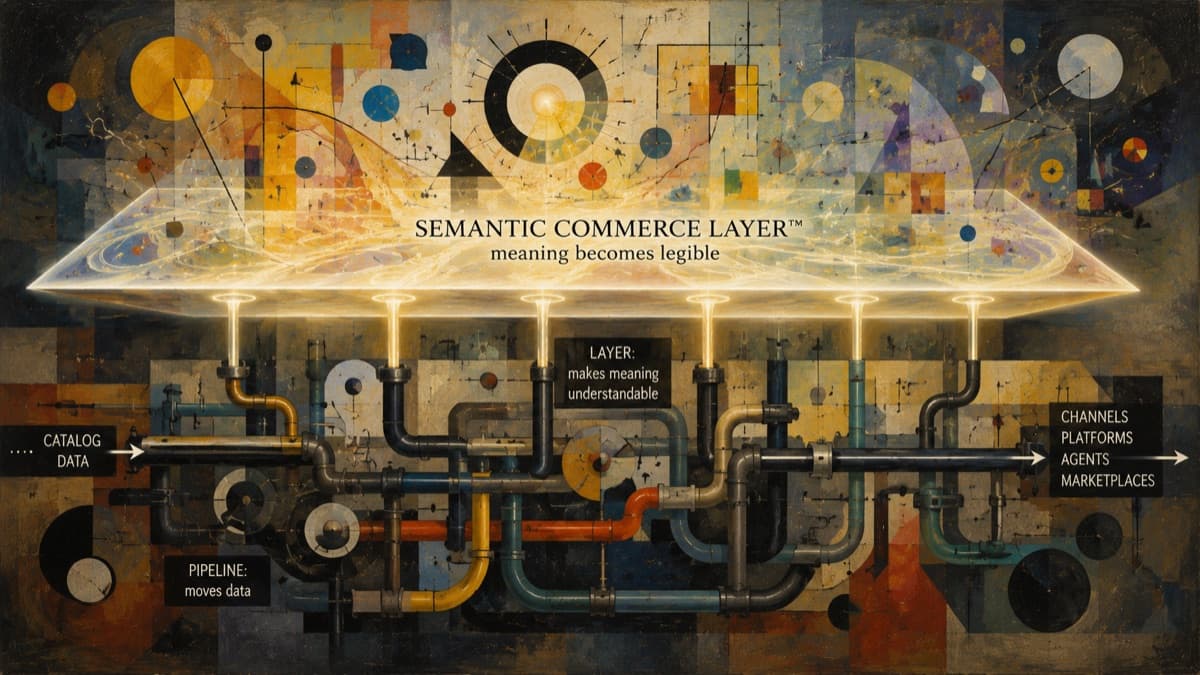
It's a fair question, and you should ask it before spending attention on anything new. You already pay for a feed management tool — something that takes your catalog and pushes it out to your channels. Isn't "making products AI-ready" just another feature bolted onto that?
The short answer is no, and the reason is worth understanding, because it's the difference between a feature and a layer.
What a feed tool is genuinely good at
Feed management tools do something essential very well: they move your catalog from where it lives to wherever it needs to go. They map your fields to each channel's required format, keep values valid, handle updates, and syndicate your products across marketplaces and platforms without you doing it by hand.
Think of it as plumbing. It gets your product data from A to B in the shape B demands. When it works, your catalog shows up everywhere it should, correctly formatted. That's real, and you should keep it.
What a feed tool was never built to do
Plumbing moves water; it doesn't decide what the water is. A feed tool moves values into slots — it doesn't establish what your product means to a machine reading it on the other end.
You can run a perfectly valid feed, mapped flawlessly to every channel, and still deliver a listing a machine can't understand — because field-mapping is about format, and understanding is about meaning. A feed tool will happily carry an ambiguous product to a hundred destinations, ambiguity intact. It did its job. The meaning job was never its job.
Feature vs layer — the distinction that matters
A feature lives inside one tool and usually serves one channel. It's a checkbox: on in that tool, gone the moment you leave it.
Interpretability can't work that way, because it has to be true everywhere your catalog goes. It's not a property of any single pipe; it's a property of the meaning itself. Whether your product is being read by an assistant, a marketplace, or an agent, the requirement is the same — the meaning has to be legible. Something that must hold across every destination isn't a feature of one destination. It's a layer that sits above all of them.
That's what the Semantic Commerce Layer™ is: a layer of meaning between your catalog and every system that reads it. It doesn't compete with your feed tool and it doesn't replace it — your feed tool still handles the plumbing. The layer makes sure that whatever the plumbing carries is actually understandable when it arrives.
(And because it's a layer over meaning rather than a channel feature, it isn't tied to your store platform either — which surprises people: Does Your Platform Decide Whether AI Understands You?)
Keep the tool. Add the layer.
None of this is a case against the software you already run. Feeds still need to be delivered, and your tool does that. The point is only that delivery and understanding are different problems, solved at different levels — and the one that decides whether the third reader can make sense of your products isn't handled by the pipe.
Moving your catalog is solved. Making it understandable is the layer on top.
Find out where your catalog stands
→ Run the free Agentic Catalog Readiness Audit™ — see whether your well-delivered catalog is also an understandable one.
→ Read the complete Research Paper — The Semantic Commerce Layer™, the full framework behind this series.
Continue the series
← Previous: You Cleaned Your Feed. Why Is AI Still Confused? · ⌂ The Semantic Commerce Layer™ (Research Paper) · → Next: Does Your Platform Decide Whether AI Understands You?
Series: The Semantic Commerce Layer™ (F-RP001) · Knowledge Domain: Foundation
NSOLVIA Intelligence — Products generate knowledge. Knowledge generates authority.