You Cleaned Your Feed. Why Is AI Still Confused?
You cleaned your feed and it passes every validator. That checks formatting, not meaning. Here is why a clean feed still isn't interpretable to AI.
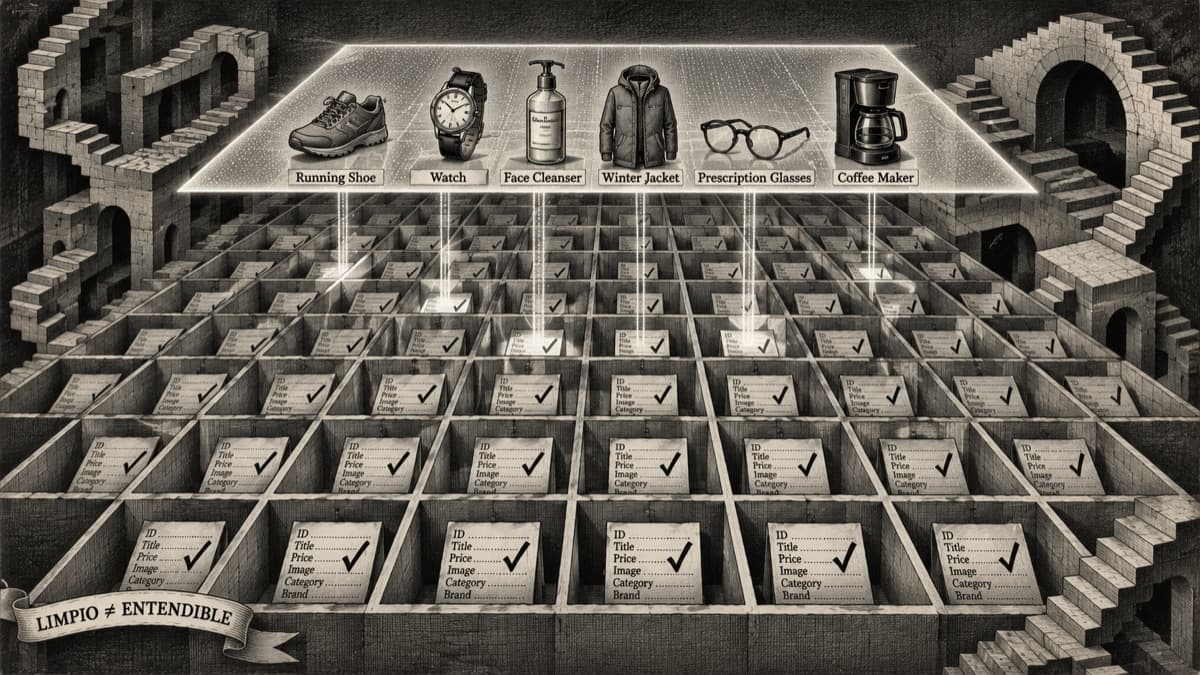
You did the work. You cleaned up the product feed, fixed the formatting, filled in the required fields, and ran it through the validator until everything came back green. By the checklist you were given, the feed is healthy.
So it's genuinely confusing to hear that AI systems might still not understand your catalog. If it's clean, if it passes, what more could a machine want?
The answer is that "clean" and "understandable" are measuring two different things — and most catalogs have only ever been graded on the first.
Three words people use as if they mean the same thing
There are three distinct jobs hiding inside "getting my product data ready," and blurring them is where the confusion comes from.
Normalization is making your data tidy and consistent — the same formats, the same units, the required fields present, no broken values. It's housekeeping, and it's necessary. It is also the part every feed validator checks.
Enrichment is adding more data — more attributes, more fields, more detail. It feels like progress because the listing gets fuller. But more data isn't automatically more meaning; you can pile on fields and still not have said the one thing a machine needed.
Interpretability is the one nobody hands you a checkmark for: whether the meaning a machine actually needs is present and resolvable — whether a system can read your product and confidently place what it is, who it's for, and when it fits.
Normalization makes the data neat. Enrichment makes it bigger. Only interpretability makes it understandable. A feed can ace the first two and still fail the third.
Where a clean feed quietly falls short
Consider something as basic as a product's category. A listing can have every required field filled, every format valid, every box ticked — and still sit under a category so generic or ambiguous that a machine can't resolve it against what a shopper is actually asking for. The feed passes. The meaning doesn't land.
That's the pattern we see again and again: a single unresolved point of meaning quietly undercutting an otherwise complete listing. Not a formatting error — the validator would catch that. A meaning gap, which no validator is built to see. The listing looks finished and reads as ambiguous, and nothing in your feed report tells you so.
This is why merchants who've done everything "right" are still surprised. Their instruments only ever measured tidiness.
Passing the spec is not the same as being understood
A feed specification is a contract about format: put these values in these slots, in this shape. Meeting it proves your data is well-formed. It says nothing about whether a machine can understand what the product is.
That's the gap a clean feed leaves open — and it's not closed by cleaning harder or adding more fields. It's closed by a layer whose whole job is meaning: the Semantic Commerce Layer™, which doesn't replace your feed or your feed tools, but makes the catalog they carry interpretable to the systems reading it.
(If it's not the cleaning and not the extra fields, isn't this just a feature of the feed tool you already pay for? Fair question — that's next: Isn't This Just the Feed Tool You Already Pay For?)
Your clean feed wasn't wasted work. It's the floor. Being understood is the part that was never on the checklist.
Find out where your catalog stands
→ Run the free Agentic Catalog Readiness Audit™ — see where your catalog reads as clean but not yet understandable.
→ Read the complete Research Paper — The Semantic Commerce Layer™, the full framework behind this series.
Continue the series
← Previous: A Human Gets Your Product Instantly. Why Doesn't the Machine? · ⌂ The Semantic Commerce Layer™ (Research Paper) · → Next: Isn't This Just the Feed Tool You Already Pay For?
Series: The Semantic Commerce Layer™ (F-RP001) · Knowledge Domain: Foundation
NSOLVIA Intelligence — Products generate knowledge. Knowledge generates authority.