The AI Standards Keep Changing. What Should You Build On?
New agentic commerce standards keep arriving. Here is why making your catalog interpretable is the one investment that outlasts whichever protocol wins.
Every few months there's a new one. A new agentic-commerce protocol, a new standard for how AI systems and stores are supposed to talk, a new announcement you're told you can't afford to ignore. It's enough to make any sensible merchant do the sensible thing: wait, because whatever you build today might be obsolete by the next headline.
The instinct to wait is understandable. It's also the one move that keeps you permanently behind. The way out isn't to guess which standard wins. It's to notice what sits underneath all of them.
The trap of chasing the protocol
If your plan is to re-tool for each new standard as it arrives, you've signed up to always be catching up. Every protocol shift means another scramble, another rebuild, another integration — and by the time you've adapted, the conversation has moved. Chasing the wire format is a race with no finish line.
And it misreads where the real requirement lives. Protocols are about how systems exchange information — the format, the handshake, the plumbing between machine and store. Useful, and genuinely changing. But they all sit on top of one requirement that never changes.
The thing every protocol assumes
No matter which standard is in fashion, the machine on the other end has to be able to understand what your product is. Every protocol assumes there's meaning worth exchanging. If your catalog can't express what a product is, who it's for, and when it fits, then it doesn't matter which protocol carries it — there's nothing coherent to carry.
That's why interpretability sits upstream of every protocol. Make your product meaning legible once, and it stays useful no matter which standard wins, because you didn't bet on the format — you invested in the thing the format is for. Wire formats expire. The need to be understood does not.
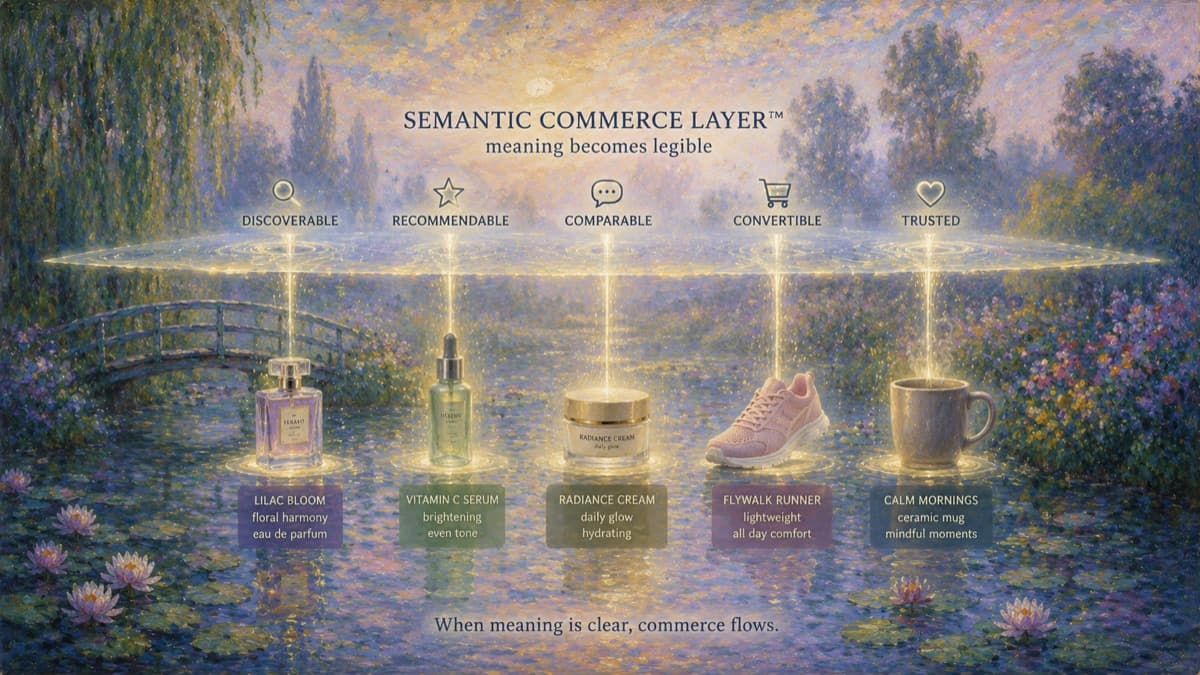
This is the whole reason the Semantic Commerce Layer™ is a layer of meaning and not an integration with any one standard. It doesn't replace your catalog, and it doesn't chase protocols; it makes what you already have interpretable — which is exactly the part that carries over from one standard to the next.
What this does — and, honestly, what it doesn't
It's worth being plain about the boundaries, because we'd rather earn trust than overpromise.
Making your catalog interpretable does not promise you a ranking, guarantee a sale, or work as a growth hack. It doesn't speak for results you haven't earned. What it does is more foundational than any of those: it makes your products understood by the systems that increasingly decide what shoppers see. Being understood isn't the finish line — it's the starting line that everything else now depends on. A product a machine can't interpret never gets the chance to compete; a product it can interpret finally does.
Where the series has been pointing
Step back and the shape is simple. Presence used to be the bar; now interpretability is. A third reader arrived that reads for meaning, not clicks. Clean feeds, more fields, better platforms, newer protocols — none of them substitute for the one thing that reader needs: to understand what your products are.
Understanding comes first. Everything a catalog can do in an agent-driven market — being structured, being known, being acted on, being measured — is built on top of being understood. That's why we treat interpretability as the foundation, not a feature: it's the layer the rest of the ecosystem stands on.
And unlike any single protocol, it's the one thing worth building on precisely because it outlasts them all. The full framework — the whole argument, and where it leads next — is in the Research Paper below.
Find out where your catalog stands
→ Run the free Agentic Catalog Readiness Audit™ — see how interpretable your catalog is today, whatever comes next.
→ Read the complete Research Paper — The Semantic Commerce Layer™, the full framework behind this series.
Continue the series
← Previous: Would You Even Know If AI Couldn't Read Your Catalog? · ⌂ The Semantic Commerce Layer™ (Research Paper) · → Next: Read the complete Research Paper — The Semantic Commerce Layer™ (series complete)
Series: The Semantic Commerce Layer™ (F-RP001) · Knowledge Domain: Foundation
NSOLVIA Intelligence — Products generate knowledge. Knowledge generates authority.