My Collections Organize the Store. Why Don't They Answer Anything?
Collections that only organize products leave machines with nothing to reason over. How categories become answers to how shoppers decide.
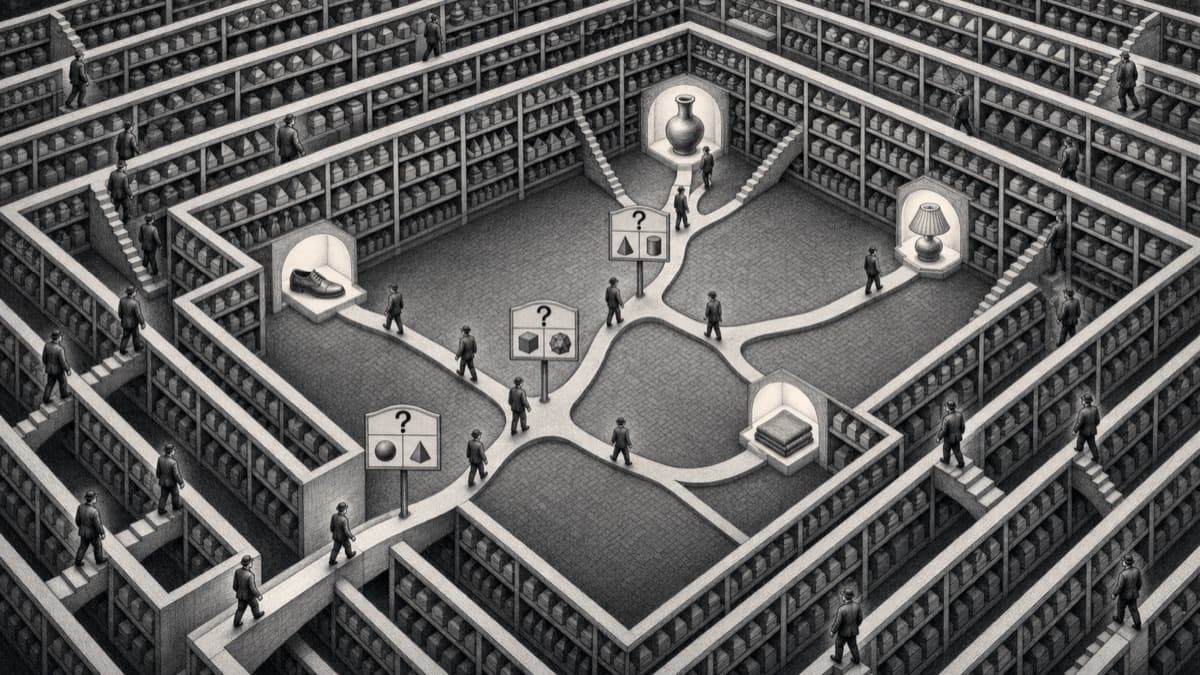
Collections were built for a browsing world. A shopper lands, scans the menu — "Candles," "New Arrivals," "Summer" — clicks, scrolls, chooses. As navigation, collections do their job.
Then the reader changed. When an AI system tries to help someone choose, it doesn't need your aisles. It needs the answers a good salesperson carries: what distinguishes these options, who is each one for, how should someone decide? Point that reader at a collection called "Bestsellers" and it learns precisely nothing about how to choose.
Containers versus answers
Look at a typical collection page through the machine's eyes: a title, maybe a sentence of intro copy, a grid of products. As data: a label and a list. The knowledge that actually drives choosing — the difference between a soy and a beeswax candle, which roast suits cold brew, what firmness means for a side sleeper — either lives in the merchant's head or is scattered across individual product pages, unconnected.
That knowledge is exactly what answer engines synthesize from and agents compare with. A collection that declares buying intent, comparative criteria and guidance-for-choosing becomes something machines can use: not an aisle, but an answer. Collections stop being navigation containers and become answers to how shoppers actually decide.
Why this front is invisible — and valuable
Merchants under-invest here for a rational reason: humans tolerate empty collections. They click through, judge by photos, self-navigate. So collection pages stay thin, and nothing visibly breaks.
But machine readers weight structure heavily — and category-level clarity is upstream of every product inside. When a collection declares its logic (who this range serves, how its options differ, what matters when picking), every product in it inherits context. Resolved against current platform taxonomies, it also connects your store's private vocabulary to the categories machine systems actually reason in. One front, compounding downstream.
The test for your own store
Open your most important collection and ask: if someone read only this page — no photos, no prior brand knowledge — could they explain how to choose between the products in it? Then the second question: could that same reader route different buyers to different products — the gift shopper, the sensitive-skin customer, the small-apartment dweller — from the page alone? If it can't do the first, the page organizes without answering. If it can't do the second, it answers only one imaginary buyer — and machines serve real, specific ones.
The Program works this as its second front — after brand, before products — turning your real category knowledge into declared structure. And the free Agentic Catalog Readiness Audit™ shows where the products beneath those collections stand today, one real product at a time.
(Next: the front where merchants have the most buried treasure — the products themselves, and the knowledge only you have.)
See where your store stands
→ Run the free Agentic Catalog Readiness Audit™ — one real product from your catalog, seen exactly as the machines see it, before and after.
→ Read the complete Pillar — NSOLVIA AI Commerce Transformation Program™, the flagship engagement this series walks through.
Continue the series
← Previous: Does My Brand Exist Outside My Logo? · ⌂ AI Commerce Transformation Program™ (Pillar) · → Next: Nobody Knows My Products Like I Do. Does That Still Count for Anything?
Series: NSOLVIA AI Commerce Transformation Program™ (D-PL001) · Knowledge Domain: Discoverability
NSOLVIA Intelligence — Understanding is only the beginning. Execution creates discoverability.