Interpretability Engine Optimization (IEO)
The UNDERSTAND Layer
"IEO" is used here for Interpretability Engine Optimization, the discipline proposed by NSOLVIA Research in 2026 and published under DOI 10.5281/zenodo.22104280. The acronym has other expansions in circulation; this work refers exclusively to the one defined here.
IEO is the practice of making a business's offers, entities, attributes, policies, and source facts machine-interpretable before downstream retrieval, recommendation, comparison, or action occurs.
Semantic discovery is downstream of interpretation.
Where IEO sits.
| Discipline | Question | Functional center of gravity |
|---|---|---|
| IEO | Can machines correctly interpret what you sell? | UNDERSTAND |
| SEO | Can they find you? | FIND |
| AEO | Can they extract you? | ANSWER |
| GEO | Can they surface and cite you? | CITE / SURFACE |
| Agentic Readiness | Can they compare, decide, act on you? | ACT |
IEO does not replace SEO, AEO, GEO or related AI optimization practices. It addresses the interpretability layer those downstream disciplines depend on. These are functional centers of gravity, not impermeable borders.
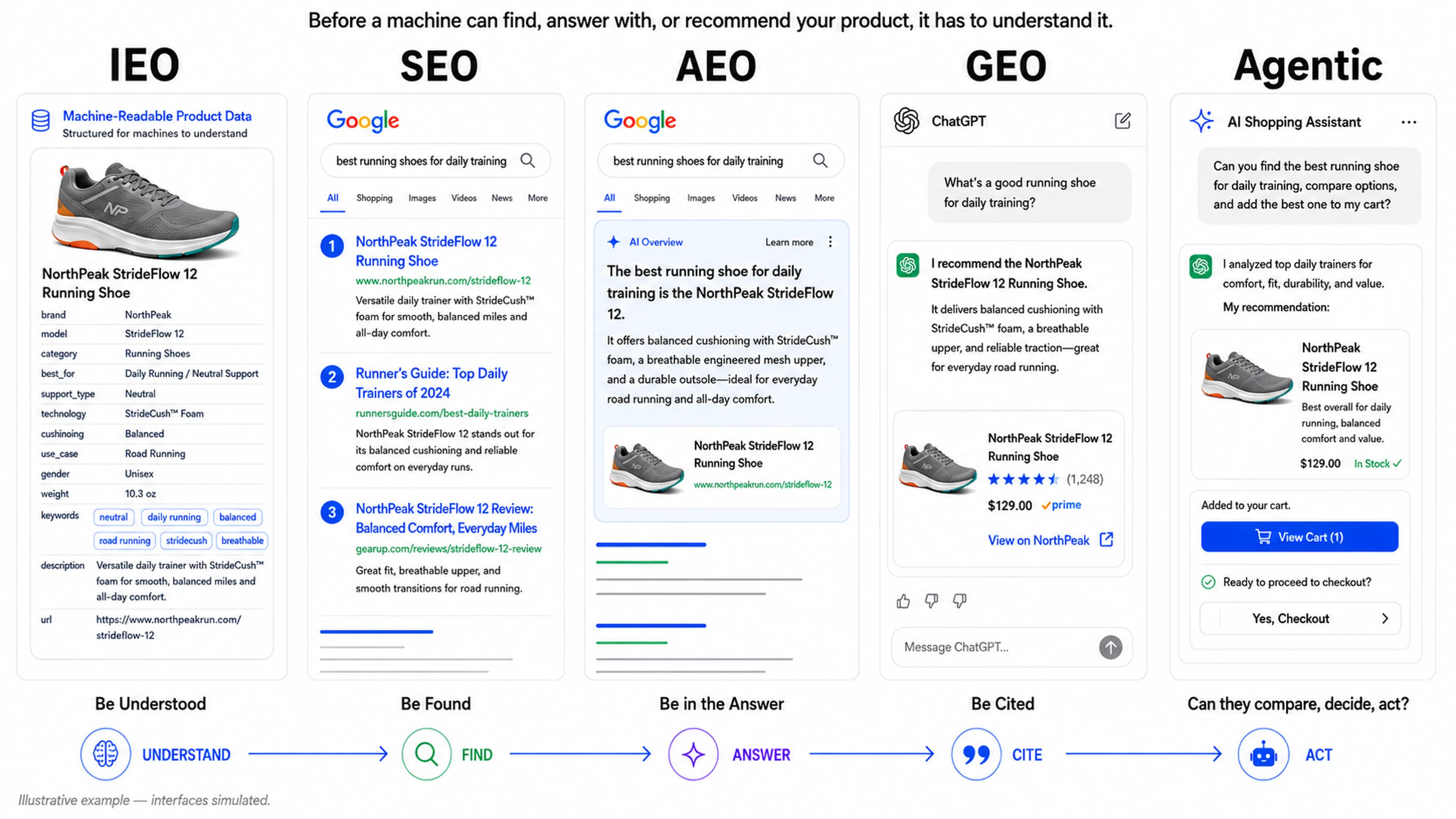
The question that precedes every other question.
Existing optimization disciplines ask whether a business is found, extracted, cited, or acted upon. None of them asks the question that comes first: can the machine correctly interpret what the business sells?
A machine may retrieve an offer it does not fully understand. It cannot reliably constrain, compare, recommend, or transact on that offer without sufficient interpretation.
THE OFFER NEVER ENTERS
A product whose machine-facing fields cannot be resolved does not lose the comparison. It may never become eligible for it.
THE WRONG RECOMMENDATION
Where data is ambiguous, generative systems may infer. An inferred material or use case is a recommendation error delivered with confidence.
THE RETURN THAT ERASES THE MARGIN
Purchases made on misinterpreted data can result in avoidable returns — double freight, handling, and a disappointed customer.
“If machines cannot interpret your business, everything downstream is built on uncertainty.”
Misinterpretation can create cost at three stages: eligibility, decision, and transaction.
A fourth effect compounds behind these three: reputation. A misinterpreted offer costs trust twice — with the buyer who received something other than what was understood, and with the system that recommended it on the strength of that data. We state this as a mechanism, not as a measured outcome.
Three objects of interpretation.
PRODUCT INTERPRETABILITY
Can the machine correctly understand what is being sold: identity, taxonomy, attributes, materials, uses, intent, restrictions, and the differences between near-identical items?
BRAND INTERPRETABILITY
Can it understand who stands behind the offer: identity, provenance, manufacturing facts, certifications, and the evidence supporting claims?
TRANSACTIONAL INTERPRETABILITY
Can it understand the rules under which the offer can be bought: price, availability, shipping, returns, eligibility, exclusions?
Product tells the machine what is being sold. Brand tells it who stands behind it. Transaction tells it under what rules it can be bought.
How to tell whether something is IEO.
“Did the intervention improve the machine's understanding of the source — or did it only improve how the source is formatted, distributed, discovered, or surfaced?”
The practical form of the test: if the same information were delivered through a different channel tomorrow, would the improvement in understanding still remain? Interpretability survives the channel; positioning does not.
A record may be valid JSON-LD, perfectly normalized, and indexed — and still be semantically ambiguous. IEO evaluates the ambiguity that remains.
Measured, projected, observed.
Three terms, and the distinction between them is not cosmetic:
- INTERPRETABILITY BASELINE
- the observed current state, measured from the source representation.
- PROJECTED INTERPRETABILITY LIFT
- the estimated improvement of a remediated version, produced before deployment.
- OBSERVED INTERPRETABILITY LIFT
- the difference measured after remediation has actually been deployed and re-evaluated.
The baseline is a measurement. The projection is an estimate. A discipline that does not separate these two will eventually mistake one for the other.
IEO does not prescribe a single score or a single instrument. Any tool that measures whether machines can correctly resolve an offer's meaning is measuring commerce interpretability.
What IEO is not.
- IEO is not keyword optimization.
- IEO is not content generation.
- IEO is not visibility tracking.
- IEO is not schema markup as such — formatting alone is not interpretation.
- IEO is not a product.
These boundaries, and where the practice sits relative to discovery, extraction, citation and action, are set out in Interpretability Engine Optimization: Terminology and Scope.
Not owned.
IEO is proposed as an open discipline. Anyone can practice it, with any tooling — manually, with enterprise systems, or with specialized instruments. It is published under a licence that lets anyone teach it, adapt it, or build competing instruments, and practising it requires no NSOLVIA tool.
NSOLVIA built a commerce-native stack to measure and automate it, and maintains this definition as a public reference. That is the extent of the claim.
An open discipline creates work beyond any single vendor: a practitioner profile around auditing, remediating and maintaining source interpretability — and room for independent instruments, validators, benchmarks and counterfactual testers built by anyone.
“IEO optimizes understanding.”
The documents.
An open discipline does not charge a toll for its own material. No form, no email, no registration.
Interpretability Engine Optimization (IEO): The Missing Optimization Layer in AI Commerce
Peer-reviewable preprint · CC BY 4.0 · permanent DOI
Interpretability Engine Optimization: Methodology — how the discipline is practiced.
22 pages · permanent DOI · CC BY 4.0 · direct download, no form
A teaching primer for researchers and students: worked examples, the replication protocol, and open problems.
19 pages · CC BY 4.0 · direct download, no form
A working guide for practitioners: the boundary test, the pipeline, and a self-assessment.
10 pages · CC BY 4.0 · direct download, no form
How to cite
López Castaño, J. C. (2026). Interpretability Engine Optimization (IEO): The Missing Optimization Layer in AI Commerce. NSOLVIA Research. Version 1.2. DOI: 10.5281/zenodo.22410276
This is the version DOI — it resolves to version 1.0 exactly as cited. https://doi.org/10.5281/zenodo.22410276
The companion series
11 articles that take this framework apart one question at a time. Interpretability Engine Optimization
- 01The Platforms Now Describe Your Products For You
- 02A Shopper Asked Google About Your Product. The Answer Was Wrong.
- 03Your About Page Says Who You Are. No Machine Can Use It.
- 04Your Product Page Is Perfect. The Sale Fails at Shipping and Returns.
- 05Meta Built Your Ad. Your Best Selling Point Stayed in a Paragraph.
- 06"Organic", "Made in Italy", "Doctor-Founded". Which of Your Claims Can a Machine Trust?
- 07Free Delivery. But Will They Carry It Upstairs?
- 08Shoppers Search Your Store for Things You Sell. And Find Nothing.
- 09Your Brand Has Three Names Online. A Machine Sees Three Companies.
- 10"Save 15%" Is on the Page. The Cancellation Policy Isn't.
- 11The Method Behind Every Before-and-After You Just Saw
Questions, answered first.
Who proposed IEO?
NSOLVIA Research proposed it in 2026. The founding paper is authored by Juan Carlos López Castaño and deposited with a permanent DOI (10.5281/zenodo.22104280).
Is IEO a replacement for SEO?
No. SEO addresses whether a business is found. IEO addresses whether machines can correctly interpret what it sells — the layer downstream disciplines depend on. A business needs both.
Do I need NSOLVIA to practice IEO?
No. IEO does not prescribe a vendor, model, data format, protocol, or software implementation. It can be practiced manually, with enterprise systems, or with any instrument that measures whether machines can resolve an offer's meaning.
Is IEO the same as structured data?
No. Structured data is a format for encoding information machines can parse. IEO is about whether there is resolved meaning to encode in the first place. A record can be valid structured data and still be semantically ambiguous.
Is this the same as interpretability in machine learning?
It is the reverse direction. In ML research, interpretability (XAI) asks whether humans can interpret the model. Commerce IEO asks whether models can interpret the merchant.
How is IEO measured?
Through resolution tasks — whether a machine can resolve identity, taxonomy, attributes, intent, use cases, trust and safety information, and retrieval language for a given offer. The founding paper documents one working instrument and an open falsifiability protocol; the discipline invites independent instruments.
Where this sits
- What it covers
- the glossary of Interpretability Engine Optimization — The canonical terminology of the discipline — 59 terms, each with its own citable anchor.
- Interpretability Engine Optimization (IEO): The Missing Optimization Layer in AI Commerce — The founding paper — the boundary test, the ladder, the three objects and the measurement approach.
- how Interpretability Engine Optimization is practiced — How the discipline is practiced — the objective, the principles, the unit of work, the four failure modes, the cycle and the falsifiability tests.
- Interpretability Engine Optimization: Terminology and Scope — The research note on the term — what it refers to, where it sits relative to discovery, extraction, citation and action, and what falls outside its scope.
- the teaching primer for Interpretability Engine Optimization — The teaching primer — the discipline entered through one product, two worked exercises, the replication protocol and the open problems.
- the practitioner's guide to Interpretability Engine Optimization — The working guide — the boundary test, the five steps, the four kinds of gap and a ten-question self-assessment.
- the Semantic Commerce Layer™ — NSOLVIA's framework for practising IEO on commerce data — the interpretability layer between catalogs and the systems that read them.
Interpretability Engine Optimization (IEO) sits inside NSOLVIA's interpretability stack — an open discipline, the framework that implements it, and the instruments that apply it.
See where your own catalog stands.
Interpretability is measurable. NSOLVIA's audit reads a real product from your catalog the way machine systems do and reports its baseline.