The Channel Put You in the Room. Your Data Decides Whether You Get Picked.
NSOLVIA Agentic Catalog Optimizer™ for Shopify — preparing Shopify catalogs for AI selection.
Executive Summary
In March 2026, Shopify switched on a new sales channel for millions of merchants at once — and most of them are losing money in it without knowing.
Shopify's agentic storefronts made product catalogs discoverable inside AI conversations: ChatGPT, Microsoft Copilot, Meta AI, and progressively Google's AI experiences. The channel is on by default, available on every plan, and it runs on one thing — structured product data. Not page design. Not brand copy. The machine-readable attributes of each product.
Shopify provides the containers. It does not fill them. When a merchant assigns a category, Shopify surfaces the attribute fields that category needs — material, intended user, defining characteristics — and those fields arrive empty. Filling them, product by product, is the merchant's job. Almost nobody does it, because nobody hand-fills hundreds of products and keeps them current.
The result is a marketplace full of stores that are present and mute: syndicated, appearing in agentic searches, and never chosen.
The NSOLVIA Agentic Catalog Optimizer™ for Shopify closes that gap. It takes the enriched, verified product data NSOLVIA already produces for a merchant and writes it into the native Shopify fields that AI channels read — nothing invented, nothing customers see rewritten. This Pillar explains the shift, why appearing is not being chosen, exactly what the Optimizer does and never touches, and — in keeping with the standard of this house — what it does not promise.
1. What the Agentic Catalog Optimizer Is
The NSOLVIA Agentic Catalog Optimizer™ for Shopify prepares Shopify catalogs to be chosen by AI shopping agents.
That sentence is precise, and every word in it carries weight.
Prepares — because the Optimizer does its work before the shopping conversation ever happens. By the time a buyer asks an AI assistant for a recommendation, the catalog either speaks the agent's language or it doesn't.
Shopify catalogs — because this product exists for one specific territory: the stores whose products are now distributed to AI channels through Shopify's own infrastructure.
Chosen — because the new competition is not about appearing in results. It is about being the product the agent actually recommends. Appearing and being chosen are different problems, and this Pillar explains why.
AI shopping agents — because the reader on the other side of your product data is no longer only a human scrolling a page. It is a reasoning system, acting on behalf of a buyer, comparing structured facts.
In one line: the Optimizer takes the enriched, verified product data that NSOLVIA already produces for a merchant, and writes it into the native fields of their Shopify store — the fields that Shopify syndicates to AI channels. Nothing is invented. Nothing visible to human customers is rewritten. The catalog simply becomes legible to the systems that now decide what gets recommended.
2. The Market Shift: A New Channel Appeared, Already Switched On
In March 2026, Shopify activated agentic storefronts for its merchants. Product catalogs across the platform became discoverable inside AI conversations — ChatGPT, Microsoft Copilot, Meta AI, and progressively Google's AI experiences — through a single mechanism: Shopify Catalog, the unified product data layer that Shopify syndicates to these channels.
Three properties of this shift matter for every merchant.
It is on by default. Eligible stores did not opt into this channel; they woke up inside it. Millions of catalogs became visible to AI shopping surfaces in a single platform decision.
It is available on every plan. This is not an enterprise feature. The smallest store and the largest operate in the same agentic marketplace, syndicated by the same catalog layer.
It runs on structured data. Shopify's own guidance to merchants is unambiguous: the setup takes minutes, but the product data optimization that determines visibility takes sustained effort. AI agents evaluate products through the structured catalog — categories, attributes, machine-readable fields — not through the visual design of a product page.
And here is the part that defines the opportunity: Shopify provides the containers, not the contents. When a merchant assigns a product category, Shopify surfaces the standard attribute fields that category calls for — the material, the intended user, the defining characteristics of that product type. Those fields are exactly what the AI channels consume. But they arrive empty. Filling them, product by product, attribute by attribute, is the merchant's responsibility.
Almost nobody does it. Not because merchants don't care — because no one hand-fills hundreds of products with structured attributes, and then keeps them current as the catalog changes.
The result is a marketplace full of stores that are technically present and practically invisible: syndicated, indexed, appearing in agentic searches — and not being chosen.
3. Appearing Is Not Being Chosen
This is the heart of the Pillar, and it deserves to be stated plainly.
In traditional search, presence was most of the battle. If your product ranked, a human saw it, judged it with human eyes — photos, price, vibe — and clicked.
In agentic commerce, the funnel has a new gatekeeper. The buyer describes a need. The agent assembles a candidate set. The agent compares candidates on the attributes the buyer cares about. The agent recommends one, or a short list. The buyer mostly sees what the agent chose to show.
Every step of that comparison runs on structured data. An agent asked for "firm-compression shapewear for post-surgery recovery, hypoallergenic" is not admiring photography. It is checking whether any candidate's data actually answers: what compression level, what material, intended for whom, suitable for what.
A product whose structured fields are empty can still appear — the title matched, the category was close enough. But at the comparison step it has nothing to say. The agent cannot verify what it cannot read, and agents are built to prefer what they can verify.
This is the gap the Agentic Catalog Readiness Audit™ (PI-PL001) measures, and the wider problem the Semantic Commerce Layer™ research describes: catalogs that machines can see but cannot understand. The Optimizer is the instrument that closes that gap inside Shopify's own channel — presence is given; eligibility is built.
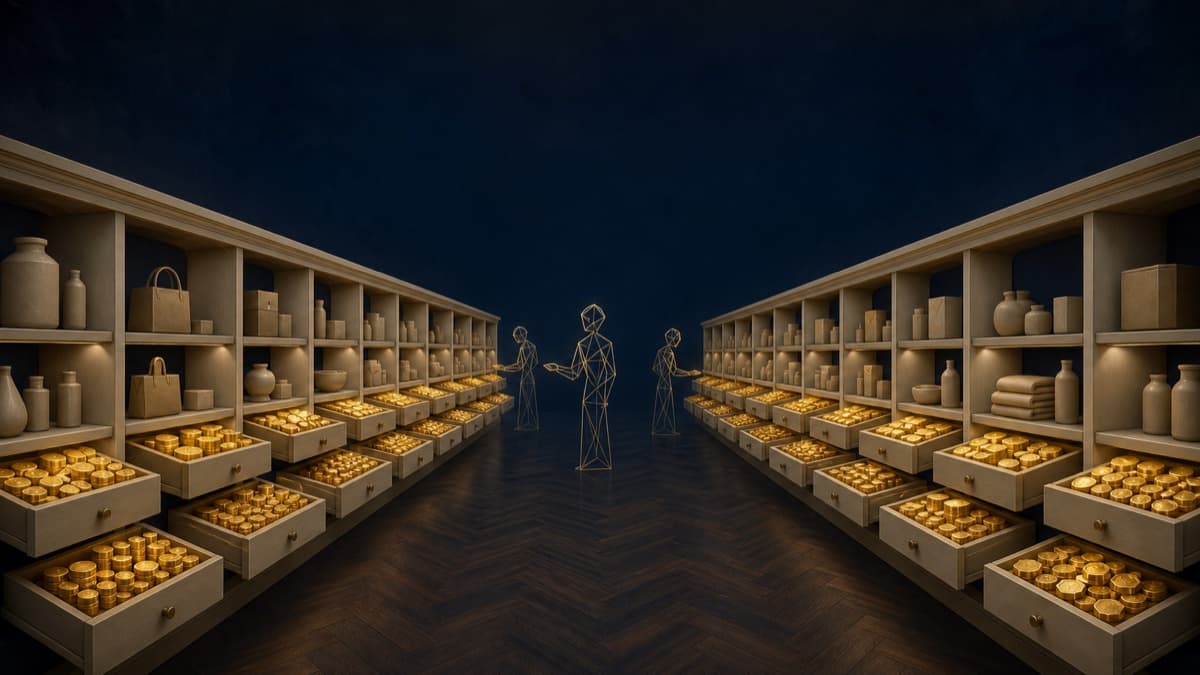
A useful way to say it to a merchant: the channel put you in the room; your data decides whether you get picked.
4. What the Optimizer Does — and What It Never Touches
The Optimizer performs one job with discipline. It takes the enriched product data that NSOLVIA already produces for the merchant — with no new ingestion and no new effort on the merchant's part — and writes it where Shopify's AI channels read.
Concretely, for every product in the catalog, the Optimizer fills three things.
The standard category attributes. The native, category-specific fields that Shopify surfaces for each product type and syndicates to AI channels — the fields that arrive as empty containers. The Optimizer supplies the values: the material, the intended user, the functional characteristics, each one grounded in what the merchant's own pages state.
An AI-facing product description. A description written for machine reasoning: rich in verified attributes, use cases, and selection criteria — the information an agent needs to justify a recommendation. It lives in its own dedicated field, alongside the merchant's original copy, never in place of it.
The search-engine metadata. The classic meta title and meta description, rewritten from the same verified data — so the catalog improves in traditional search as a side effect of becoming agent-ready.
Equally important is what the Optimizer never touches.
It does not rewrite the merchant's human-facing copy. The product title customers see, the brand voice in the description, the storytelling a merchant has refined for years — untouched. The Optimizer writes machine-facing data into machine-facing fields. The storefront your customers experience remains exactly the store you built.
It does not touch prices, inventory, or promotions. Shopify already synchronizes dynamic commercial data to AI channels in real time. The Optimizer works on the semantic layer — what a product is, what it's for, who it serves — the layer that changes rarely and decides eligibility.
One source, three expressions. All three outputs — the category attributes, the AI-facing description, the search metadata — are expressions of one and the same thing: the enriched, verified product data NSOLVIA already produces for the merchant. That is why they never contradict each other, and why the data runs deep: not just materials and use cases, but usage recommendations and the merchant's own warnings, preserved exactly as published. Competitors fill fields one guess at a time; the Optimizer expresses one complete, verified understanding of each product — three ways.
Transparency without bottlenecks. Nothing is written in the dark, and nothing waits in an approval queue either. The working model is built for owners with businesses to run: the merchant sees the quality up front on their own product — the free audit shows a real product, before and after, and can be run again on another — the optimization then runs across the catalog, and the merchant reviews a sample of the results. If anything doesn't sit right with the store, it is corrected quickly; and since every value traces back to the merchant's own pages, "wrong" is rare by construction. Everything written is reversible. It is the merchant's property; NSOLVIA behaves accordingly — without asking the owner to hand-approve five hundred products one comma at a time.
5. Fabricated From Truth, Not Moved From a Spreadsheet
A reasonable reader will ask: don't feed tools already do this?
They do something that sounds similar and is fundamentally different. The dominant tooling in this space moves data: it takes whatever already sits in the product record and reformats it, maps it, ships it. If the material field is empty, a mapper ships an empty field — faster.
The Optimizer belongs to a different lineage — the same one as AI-Ready Commerce Feeds™ (PI-PL002), its sibling in Product Intelligence. Both deliver the enriched catalog; they differ in the world they serve. Feeds delivers it outward, formatted for each external platform's specification — one catalog, many destinations. The Optimizer delivers it inward: it loads the enriched data into the product itself, inside Shopify, where that platform's own agentic channel reads it. Unlike a feed that ships your data out, the Optimizer writes it into the product record — no destination spec, no external delivery. The data becomes part of the store.
What both share — and what no mover has — is where the data comes from. NSOLVIA fabricates it: derived from the merchant's own published pages, normalized, categorized, and verified before a single field is written. The house rule applies without exception: verified, never invented. If the merchant's pages don't say it, the Optimizer doesn't write it. Warnings and safety statements are preserved exactly as the merchant published them. The result is a catalog an AI agent can trust — because every claim in it traces back to something the merchant actually said.
That is the difference between filling fields and filling fields with the truth. Agents are comparison machines; the merchant who wins the comparison is the one whose structured data is both complete and verifiable.
6. Who It's For — and When It Isn't
The Optimizer is for merchants on Shopify — any plan — whose products now live in the agentic channel and whose structured fields are empty or thin. In practice that describes the overwhelming majority of stores: present, syndicated, and silent at the comparison step.
It is especially decisive for merchants in attribute-driven verticals — apparel, beauty, wellness, home — where the buyer's question is never just "show me X" but "which X is right for me": what material, what level, what size logic, suitable for what situation. Those are precisely the questions structured attributes answer.
It also serves the largest stores. Higher-tier Shopify plans add more sophisticated data-mapping plumbing, but plumbing does not fill fields. The work that determines eligibility — resolving the right category, populating every attribute with a correct value, writing descriptions an agent can reason over — remains manual at every plan level. The Optimizer does that work regardless of the plan.
When is it not the right product?
- A merchant not on Shopify doesn't need the Optimizer — they need the enriched catalog delivered to their platforms, which is the territory of AI-Ready Commerce Feeds™ and the wider NSOLVIA DATA™ family.
- A merchant whose priority is how their brand and pages present to AI systems and search on the open web is looking at a different NSOLVIA product line dedicated to discoverability — a complementary layer, not this one.
- A merchant with a handful of products and the discipline to maintain structured fields by hand can do this work themselves. The Optimizer's value scales with catalog size and with change: the more products, and the more they evolve, the less realistic manual upkeep becomes.
And because catalogs are living things, the Optimizer is not a one-time event. Products are added; formulations change; pages get rewritten. The Optimizer keeps the machine-facing layer current as the catalog moves — so the merchant does what merchants should do: sell. The data stays ready on its own.
7. What It Does Not Promise
Honesty is a feature of this product, so the boundaries belong in its Pillar.
The Optimizer does not promise that an agent will choose your product. No one can promise that — the agent's decision belongs to the agent, and it weighs factors beyond data quality: price, availability, reviews, the buyer's own constraints. Any vendor promising guaranteed selection in AI channels is promising something they do not control.
What the Optimizer delivers is eligibility: a catalog whose structured data is complete, correct, verifiable, and written exactly where the agentic channel reads it. It moves a merchant from "present but mute" to "present and fully legible" — from a candidate the agent must skip past to a candidate the agent can actually evaluate.
It does not replace the merchant's own work where humans are irreplaceable: earning reviews, pricing competitively, photographing products well, serving customers. Structured data decides whether the agent can consider you; the merchant's business decides whether you deserve to win.
And it does not touch what makes the store the merchant's own. The brand voice, the human copy, the storefront — those stay exactly as built. The Optimizer works in the layer customers never see and agents never stop reading.
Prepared catalogs get considered. That is the promise, that is the product, and in the agentic era, that is the new ground floor of commerce.
Get ready for AI selection.
Run the free Agentic Catalog Readiness Audit™ →
Read the research behind it — The Semantic Commerce Layer™ (F-RP001), the framework this product is built on.
Once a catalog is ready, the next step is delivery. Explore NSOLVIA DATA — how a ready catalog becomes clean, agent-consumable feeds.
Knowledge Domain: Product Intelligence · Document: PI-PL003 · Pillar
NSOLVIA Intelligence — Products generate knowledge. Knowledge generates authority.
NSOLVIA Agentic Catalog Optimizer™ for Shopify, AI-Ready Commerce Feeds™, Agentic Catalog Readiness Audit™, Agentic Catalog Readiness Score™, NSOLVIA DATA™ and The Semantic Commerce Layer™ are trademarks of NSOLVIA. © NSOLVIA · Juan Carlos Lopez, Founder.