Do You Know Your Catalog Score for the Agentic Era?
You measure SEO, ads, and conversion. But do you know how ready your catalog is for AI agents? Here is why that score matters now.
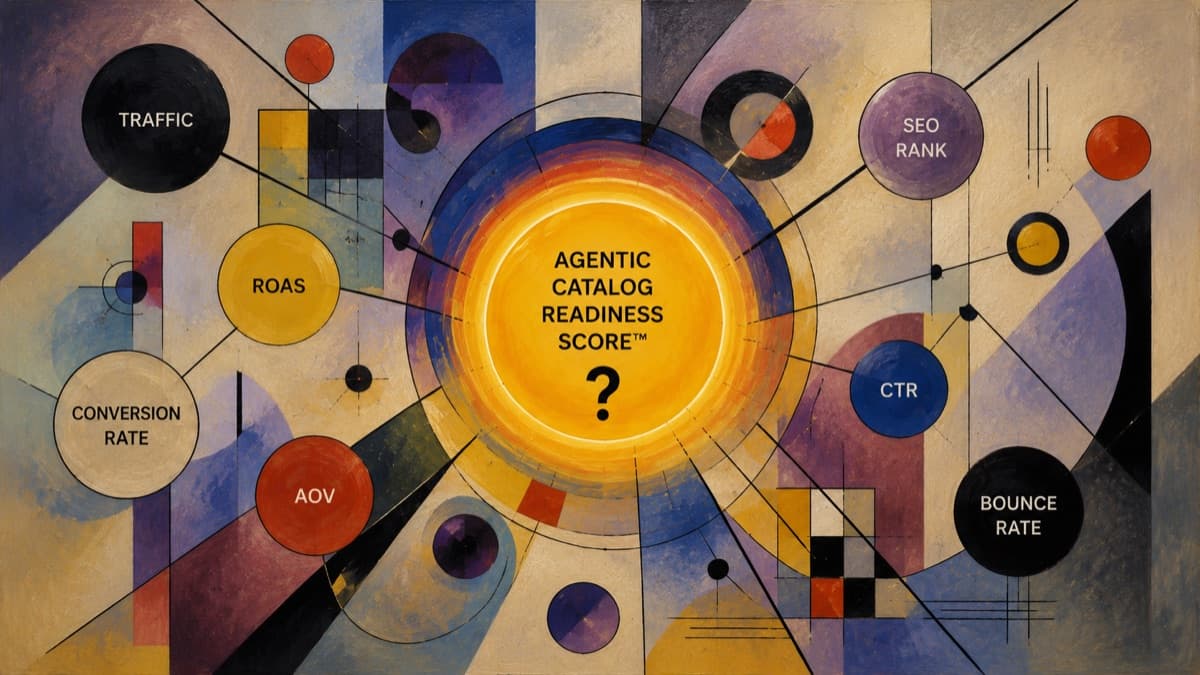
You already live by scores.
You track your SEO ranking. You watch your ad performance. You measure conversion rate, cart abandonment, return rate. Every part of your store has a number attached to it.
But there is one number almost no merchant has: how ready your catalog is to be understood by AI agents.
That is the number that is about to matter most.
Why a new score, now
For years, the scores that mattered were about people finding you. Search ranking. Click-through. Conversion.
Those scores assume a human is doing the choosing.
Agent-mediated commerce changes the chooser. When an AI agent decides which products to surface, it is not influenced by your ad spend or your brand recognition. It reads your product data and makes a call based on how clearly that data communicates.
So a new question appears — one your existing scores cannot answer:
Can an AI system understand and confidently recommend this product?
The Agentic Catalog Readiness Score™ exists to answer exactly that.
What the score actually represents
The score is a single number, from 0 to 100, that expresses how legible your catalog is to machines.
It is not a marketing metric. It does not measure how good your products are, or how well they sell to people today. It measures something narrower and more specific: whether the data around a product is clear, complete, and structured enough for an agent to act on.
A high score means an agent can read your product, understand what it is and what it is for, and recommend it with confidence.
A low score means the agent has to guess — and agents do not guess. They move on.
Why one number is useful
A single score does something important: it makes an invisible problem measurable.
Most merchants have no way of knowing where they stand with AI systems. The catalog looks finished. Sales may be fine. There is no error message that says "an agent could not understand this product."
The score turns that silence into something you can see, track, and improve. It gives you a baseline today and a way to measure progress tomorrow.
But the single number is only the entry point. The real insight comes when you look underneath it — because that one score is actually built from three very different things.
Where the score comes from
The framework behind the score was shaped by a large body of real-world catalog audits, across the major commerce platforms and many product types.
One pattern stood out. Two catalogs can carry nearly identical scores on the surface and still be strong in completely different ways underneath — one solid in structure, another rich in meaning, another exposed cleanly to machines.
That is why the score is never just one number. It is three.
Which raises the next question: Why Can Two Catalogs Look Identical but Perform Very Differently for AI?
What to do with your score
Get your score first. It costs nothing, and it tells you where you stand.
Then treat it as a starting line, not a grade. A low score is not a failure — it is a map of where the opportunity is.
Because in an agent-driven market, the merchants who know their readiness are the ones who can improve it. And the ones who never checked are the ones quietly being skipped.
Find out where your catalog stands
→ Run the free Agentic Catalog Readiness Audit™ — get your score across all three dimensions.
→ Read the complete Pillar Document — Agentic Catalog Readiness Audit™, the full framework behind the score and what it means for merchants.
→ Understand the discipline — the audit measures your Interpretability Baseline, part of Interpretability Engine Optimization (IEO): the open discipline of making commerce data machine-interpretable before retrieval, recommendation, comparison or action occurs. NSOLVIA proposed it and published it openly.
Continue the series
← Previous: Would an AI Agent Recommend Your Products Today? · ⌂ The Agentic Catalog Readiness Audit™ (Pillar) · → Next: Why Can Two Catalogs Look Identical but Perform Very Differently for AI?
Series: Agentic Catalog Readiness Audit™ · Knowledge Domain: Product Intelligence
NSOLVIA Intelligence — Products generate knowledge. Knowledge generates authority.